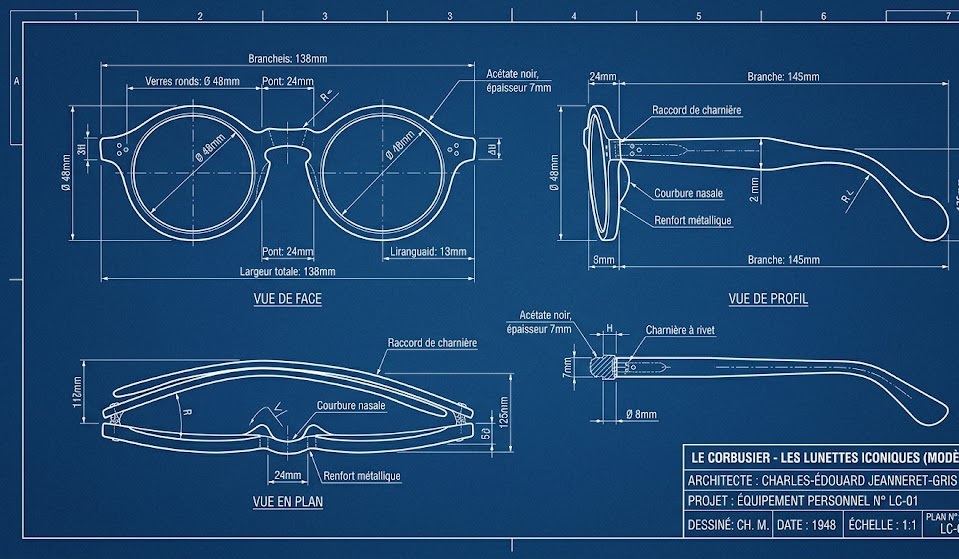
Charles-Edouard Jeanneret, known universally as Le Corbusier, is remembered for buildings. The Villa Savoie, the Chandigarh Capitol Complex, the Modulor proportioning system that attempted to reconcile human scale with architectural geometry. But ask someone to picture Le Corbusier and they will see the glasses first: thick, perfectly round, black frames that sat on his face like a geometric assertion.
Those glasses were not incidental to his public identity. They were integral to it. Le Corbusier understood, perhaps more intuitively than explicitly, that the face is the primary architecture most people encounter daily, and that eyewear modifies that architecture as fundamentally as a facade modifies a building.
The circle as statement
Le Corbusier’s frames were round at a time when round glasses were not fashionable. In the 1920s and 1930s, when his public persona was solidifying, the dominant eyewear shapes were oval and rectangular. His choice of a perfect circle was a deliberate departure, consistent with his broader aesthetic philosophy that favored pure geometric forms.
In his architectural work, Le Corbusier argued that the circle, the square, and the triangle were the fundamental shapes that produced emotional responses in observers. He called them the “engineer’s aesthetics” and considered them morally superior to ornamental complexity. His buildings are full of these forms: cylindrical pilotis, rectangular planes, circular windows.
His glasses applied the same logic to his face. The perfect circle introduced a geometric clarity to his features that photographs captured and amplified. In every image, the round frames create two focal points that anchor the viewer’s attention and give his face a structural quality that complements his sharp jawline and angular features.
Eyewear as architectural element
The parallel between eyewear and architecture is more direct than metaphor suggests. Both disciplines deal with structure, proportion, and the relationship between form and the human body. A frame sits on the face the way a facade sits on a building: it mediates between interior and exterior, between the private self and the public presentation.
Le Corbusier’s round frames functioned architecturally on his face in several ways. They created symmetry along the vertical axis, balanced the width of his forehead against the narrower lower portion of his face, and established a visual rhythm that repeated in his bow tie and the circular motifs of his designs. Whether he was conscious of these effects or simply drawn to the shape instinctively, the result was a face that looked designed.
This is the distinction between wearing glasses and using glasses. Most people wear frames that serve a corrective function with some consideration for aesthetics. A few people, historically architects and designers among them, use frames as a compositional element that participates in the overall visual construction of their appearance.
The intellectual signifier
Round glasses acquired an association with intellectualism that persists to this day, and Le Corbusier is one of the figures responsible for establishing that code. The list of twentieth-century thinkers photographed in round frames is remarkable in its consistency: John Lennon, Mahatma Gandhi, Steve Jobs in his later years, Harry Potter in fiction. Each of these associations reinforced the connection between circular frames and cerebral identity.
The mechanism is partly geometric. Round shapes read as softer, more introspective, and less aggressive than angular ones. A rectangular frame sharpens the face and suggests action. A round frame softens it and suggests reflection. When combined with Le Corbusier’s specific brand of intellectual authority, his round frames helped establish a visual shorthand that culture has used for decades.
This shorthand has its limitations. It can tip into caricature when the frames are too large or too perfectly circular. It can read as affectation when the wearer’s persona does not support the intellectual signaling. But as a baseline, round frames still carry a whisper of the same authority that Le Corbusier projected in every photograph.
The legacy in contemporary eyewear
Le Corbusier’s specific frame style, thick perfectly round acetate in black, has been reinterpreted by virtually every eyewear brand at some point. The shape appears in independent collections as a reference to modernist design history and in mass-market lines as a generic “intellectual” option.
What most contemporary interpretations miss is the intentionality. Le Corbusier’s glasses worked because they participated in a complete visual identity. They matched his bow tie, his architectural drawings, his buildings, and his philosophical commitments. They were one element in a coherent system.
Wearing round glasses today without that systemic coherence is not wrong, but it is incomplete. The frame shape is still powerful, still capable of reorganizing how a face reads. But it achieves its full potential only when the wearer treats it the way Le Corbusier treated it: not as an accessory to put on but as an architectural decision about how their face meets the world.
The face is the first building anyone sees. The frames are the facade. Le Corbusier understood this, and his glasses prove it in every photograph that survives him.