In 1972, the same year Minoru Yamasaki’s Pruitt-Igoe housing project in St. Louis was demolished — an event that architectural critic Charles Jencks would later call the death of modernist architecture — European eyewear manufacturers were producing some of the most aggressively geometric frames in the history of the medium. The coincidence is not accidental.
Brutalism and the bold eyewear of the 1970s share more than a moment in time. They share a design philosophy: the belief that structure itself is expressive, that material honesty is an aesthetic virtue, and that the refusal of ornamentation is a form of conviction rather than austerity.
What brutalism actually was
Brutalism is frequently misunderstood as a synonym for ugly. The name contributes to this. It derives not from the English adjective but from the French béton brut — raw concrete — a term Le Corbusier used to describe the unfinished, board-marked concrete surfaces he championed as architecturally legitimate.
The brutalist position was philosophical before it was aesthetic. The concrete was left raw because finishing it would be dishonest. Exposing the structure — the load-bearing elements, the service ducts, the construction logic — was a statement about authenticity. The building should look like what it is, not what a surface treatment could make it appear to be.
This philosophy had a specific historical context. Post-war reconstruction across Europe and the United Kingdom produced an enormous demand for social housing, civic buildings, and institutional architecture. The architects who responded to this demand were often working within modernist traditions that had already established a skepticism toward decoration. Brutalism was the maximalist expression of that skepticism.
The material politics
Concrete was also, crucially, cheap. The social housing programs that commissioned the most recognizable brutalist buildings were operating under significant budget constraints. A material that was structural, fireproof, and required no additional finishing addressed multiple problems simultaneously.
But cheap materials, in the hands of architects who understood their qualities, can produce work of genuine power. The raw concrete surfaces of buildings like Paul Rudolph’s Art and Architecture Building at Yale, or Lasdun’s National Theatre in London, are not apologetic about their economy. They are transformed by attention into something that operates as pure surface — textured, massive, light-absorbing in ways that traditional masonry cannot replicate.
The material is doing what material does, without pretense.
Eyewear and the structural turn
The eyewear design of the early to mid-1970s was responding to many of the same cultural pressures as brutalist architecture, though through entirely different channels. The post-war period had produced a generation of designers trained in modernist principles who were now applying those principles to consumer objects.
The dominant eyewear aesthetic of the late 1950s and early 1960s had been ornamental — cat-eye frames with rhinestone accents, curved temples with decorative inlays, the exuberance of a culture that had emerged from scarcity into affluence. By the late 1960s, this aesthetic was beginning to feel excessive.
The 1970s response was structural. Frames became geometric. The oval, the round, and the winged cat-eye gave way to the hard rectangle, the square, and the octagon. Acetate was cut and formed with visible precision. The hinge became a design element rather than a necessary mechanism to be hidden. The construction logic of the frame was made apparent.
The thick acetate frame
The vehicle for this structural turn was thick acetate. The material had been available since the 1930s but was used primarily to simulate tortoiseshell and horn — materials associated with traditional optical frames. In the 1970s, designers began treating acetate on its own terms.
Thick acetate cut into hard geometric shapes does something visually that no other frame material replicates. The depth of the material creates shadow and volume. The frame reads as three-dimensional rather than linear. Where a wire frame describes space, a thick acetate frame occupies it.
This occupation of space — the willingness of the object to be present — is directly analogous to what brutalist architects were doing with exposed concrete. The building does not retreat into its context. The frame does not disappear against the face. Both announce their existence as objects.
The color question
Brutalism’s most visible limitation as a public architecture is also its most frequently cited: the concrete grays. Buildings that were designed to weather and develop character through exposure instead developed staining, water damage, and a universally damp appearance in temperate climates. The material’s beauty under ideal conditions — the sharp shadow lines of afternoon sun on board-marked concrete — was rarely the condition that most inhabitants experienced.
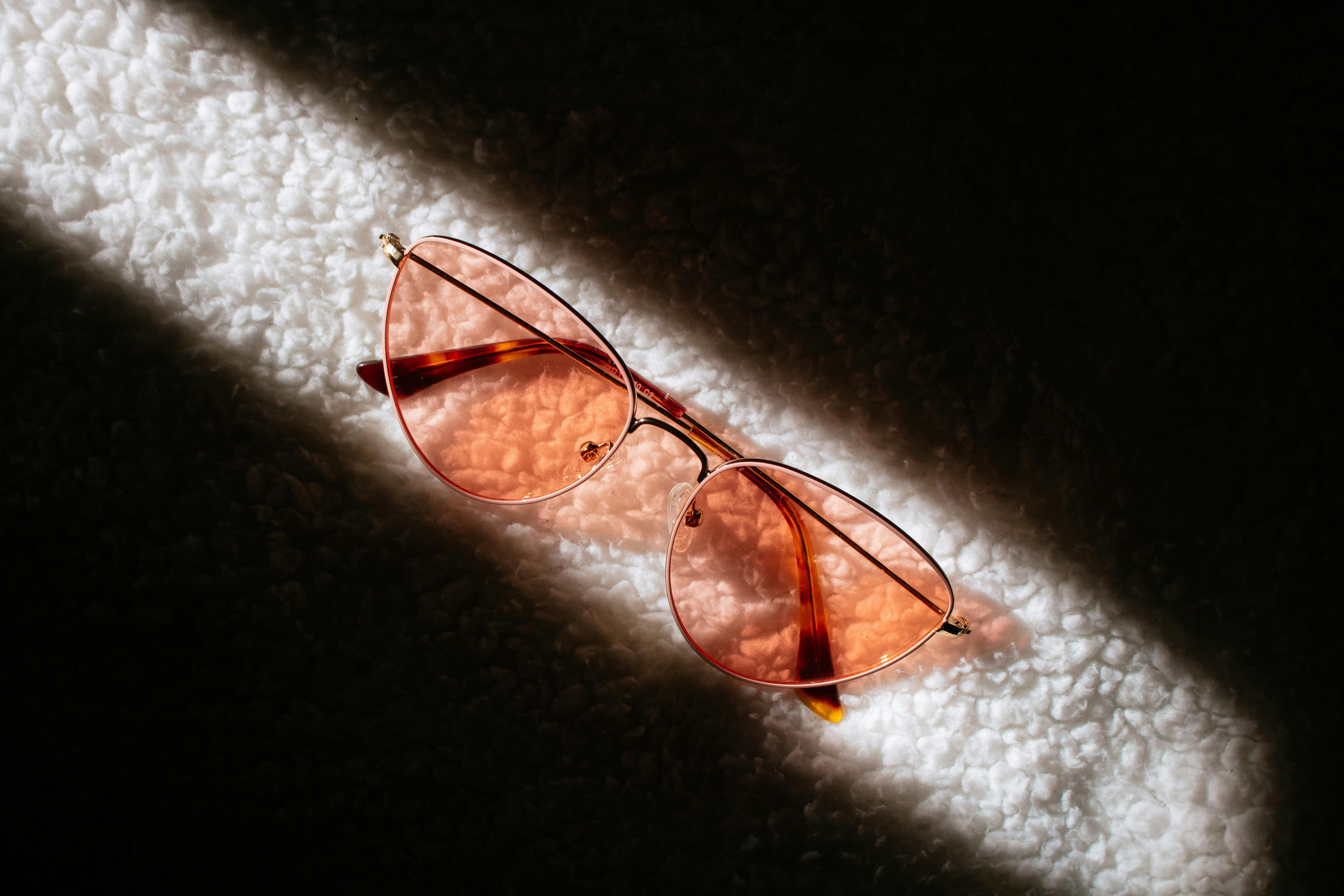
1970s eyewear avoided this problem by leaning into color at precisely the moment architecture was retreating from it. The thick acetate frames of the period appear in amber, in deep brown, in olive, in burgundy — colors that aged well, that photographed warmly, and that accumulated rather than deteriorated. The structural ambition came with chromatic richness that the architecture could not manage.
The legacy
Brutalist architecture had a complex twentieth century. The housing projects that were its most socially ambitious expressions became, in many cases, its most visible failures — not because the architecture was wrong but because the social programs that were supposed to maintain them were never adequately funded. The style became associated with its most mismanaged examples rather than its most resolved ones.
The bold eyewear of the 1970s had a simpler trajectory. It went out of fashion in the 1980s, returned in the 1990s as retro nostalgia, went out again, and has been in sustained revival since the mid-2010s as the independent eyewear market rediscovered what thick acetate at geometric scale can do.
The design logic was sound. The material was right. The problem was that it took forty years to find a cultural context that could accommodate it again.
That context is the present moment. The structural frame — heavy acetate, geometric, unambiguous about its own presence — is the dominant aesthetic of contemporary independent eyewear. Brutalism never really died. It just moved off concrete and onto faces.